Understanding Autobiography Essentials

0% found this document useful (0 votes)
440 views5 pages
This document outlines a lesson plan on creative non-fiction for Grade 12 students. It discusses autobiography as the topic, defining it and its types. The lesson plan provides examples of different types of autobiographies and how to write one. Students will analyze autobiographies, write their own autobiography draft, and answer questions to assess their understanding of the topic. The overall goals are for students to understand autobiography and be able to write their own.

Uploaded by

Ann Fuentes
License
© All Rights Reserved
We take content rights seriously. If you suspect this is your content, claim it here.
Available Formats
Download as DOCX, PDF, TXT or read online on Scribd
  • Introduction
  • Understanding Autobiography
  • Example of Autobiography
  • How to Write an Autobiography
  • Tasks and Activities

Republic of the Philippines

Department of Education
Region VI-Western Visayas
Division of Negros Occidental
HINIGARAN NATIONAL HIGH SCHOOL
Senior High School Department
S.Y. 2022-2023

Week 2 (March 7 – 8, 2023)

Subject Area: Creative Non-Fiction

Content: AUTOBIOGRAPHY

Content Standard: The learners understand the distinction between and among creative nonfiction types
and forms.

Performance Standard: The learners competently deliver artistic presentation summarizing and analyzing
the form, theme and techniques of a chosen creative nonfiction text

Learning Objectives: At the end of the class period, the Grade 12 students will be able to;
a.) Define autobiography and its types;
b.) Write their own autobiography; and
c.) Demonstrate appreciation of the purpose and importance of autobiography and its
types.

Time Duration: 120 minutes (Two Class Period)

Materials: Chalk, Chalkboard, Television.

-oOo-

Pre-Activity
 Start the class with a prayer.
 Ask the students to arrange their chairs properly.
 Checks attendance
 Ask the students how they feel today.

Activity

 Quick Review on the Types and Forms of Creative Nonfiction


The teacher will ask the following questions:

1. What are the different Types and Forms of Creative Nonfiction?


2. Is it important to understand the functions of each type and form of creative nonfiction?
Why?

 Exploratory Activity
The class will play the game “Social Media Icebreaker”

The teacher will let the students go through their social media accounts to choose a photo that they
feel best represent themselves and share it to their chosen partner. The class will be given 5 minutes for
this activity.

Analysis

The teacher will ask the class the following questions based on the exploratory activity:
 What was the activity about?
 How do you feel about the activity?
 What have you discovered during the activity?

The teacher will then present the topic of the day through a Mini-Lecture.

Autobiography
 came from the Greek word “Autos” – Self, “Bios” – Life, and “Graph” – Printed or Written
that literally means a self-written account of one’s life.
 It is a story written by the person himself.
 In an Autobiography, a person tells the story of his or her own life. Because of this,
Autobiographies are told in First-Person Point of View.
 An autobiography includes information about themselves. It can also include one’s
thoughts, feelings, and moods.
 An autobiography is written by a person whose life it’s about, with the intention of being
published.

Types of Autobiography

There are many types of autobiographies. Authors must decide what purpose they have for
writing about their lives, and then they can choose the format that would best tell their story.

Most of these types all share common goals: helping themselves face an issue by writing it
down, helping others overcome similar events, or simply telling their story.

 Full Autobiography
This would be the complete life story, starting from birth through childhood, young
adulthood, and up to the present time at which the book is being written. Authors might
choose this if their whole lives were very different from others and could be considered
interesting.

 Memoirs
There are many types of memoirs – place, time, philosophic (their theory on life),
occupational, etc. A memoir is a snapshot of a person’s life. It focuses on one specific
part that stands out as a learning experience or worth sharing.

 Psychological Illness
People who have suffered mental illness of any kind find it therapeutic to write down their
thoughts. Therapists are specialists who listen to people’s problems and help them feel
better, but many people find writing down their story is also helpful.

 Confessions
Just as people share a psychological illness, people who have done something very
wrong may find it helps to write down and share their story. Sharing the story may make
one feel he or she is making amends (making things right), or perhaps hopes that others
will learn and avoid the same mistake.

 Spiritual
Spiritual and religious experiences are very personal. However, many people feel that it’s
their duty and honor to share these stories. They may hope to pull others into their
beliefs or simply improve others’ lives.

 Overcoming Adversities
Unfortunately, many people do not have happy, shining lives. Terrible events such as
robberies, assaults, kidnappings, murders, horrific accidents, and life-threatening
illnesses are common in some lives. Sharing the story can inspire others while also
helping the person express deep emotions to heal.
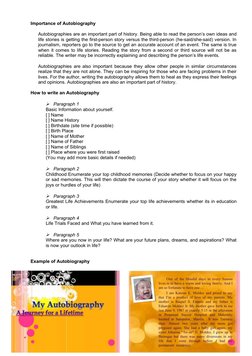
Importance of Autobiography

Autobiographies are an important part of history. Being able to read the person’s own ideas and
life stories is getting the first-person story versus the third-person (he-said/she-said) version. In
journalism, reporters go to the source to get an accurate account of an event. The same is true
when it comes to life stories. Reading the story from a second or third source will not be as
reliable. The writer may be incorrectly explaining and describing the person’s life events.

Autobiographies are also important because they allow other people in similar circumstances
realize that they are not alone. They can be inspiring for those who are facing problems in their
lives. For the author, writing the autobiography allows them to heal as they express their feelings
and opinions. Autobiographies are also an important part of history.

How to write an Autobiography

 Paragraph 1
Basic Information about yourself.
[ ] Name
[ ] Name History
[ ] Birthdate (site time if possible)
[ ] Birth Place
[ ] Name of Mother
[ ] Name of Father
[ ] Name of Siblings
[ ] Place where you were first raised
(You may add more basic details if needed)

 Paragraph 2
Childhood Enumerate your top childhood memories (Decide whether to focus on your happy
or sad memories. This will then dictate the course of your story whether it will focus on the
joys or hurdles of your life)

 Paragraph 3
Greatest Life Achievements Enumerate your top life achievements whether its in education
or life.

 Paragraph 4
Life Trials Faced and What you have learned from it.

 Paragraph 5
Where are you now in your life? What are your future plans, dreams, and aspirations? What
is now your outlook in life?

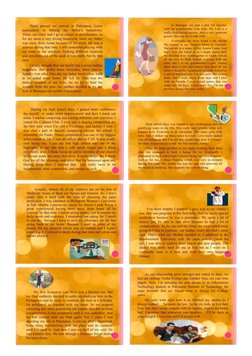
Example of Autobiography
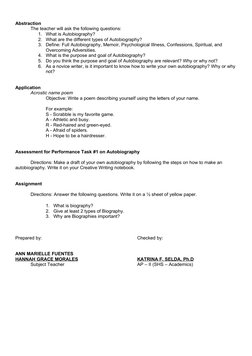
Abstraction
Abstraction
The teacher will ask the following questions:
1. What is Autobiography?
2. What are the different types of Autobiography?
3. Define: Full Autobiography, Memoir, Psychological Illness, Confessions, Spiritual, and
Overcoming Adversities.
4. What is the purpose and goal of Autobiography?
5. Do you think the purpose and goal of Autobiography are relevant? Why or why not?
6. As a novice writer, is it important to know how to write your own autobiography? Why or why
not?

Application
Acrostic name poem
Objective: Write a poem describing yourself using the letters of your name.

For example:
S - Scrabble is my favorite game.
A - Athletic and busy.
R - Red-haired and green-eyed.
A - Afraid of spiders.
H - Hope to be a hairdresser.

Assessment for Performance Task #1 on Autobiography

Directions: Make a draft of your own autobiography by following the steps on how to make an
autobiography. Write it on your Creative Writing notebook.

Assignment

Directions: Answer the following questions. Write it on a ½ sheet of yellow paper.

1. What is biography?
2. Give at least 2 types of Biography.
3. Why are Biographies important?

Prepared by: Checked by:

ANN MARIELLE FUENTES


HANNAH GRACE MORALES KATRINA F. SELDA, Ph.D
Subject Teacher AP – II (SHS – Academics)

Common questions

Powered by AI

Autobiographies focusing on overcoming adversities inspire readers by demonstrating real-life examples of resilience and the human capacity to endure and triumph over challenging circumstances. Such stories provide readers with hope and motivation, illustrating that it is possible to overcome obstacles and emerge stronger. These narratives impact societal perceptions by highlighting the strength and potential for growth in adversity, fostering a more empathetic and resilient community mindset. They encourage readers to re-evaluate their challenges, potentially shifting societal attitudes towards challenging circumstances and triumph over adversity .

Autobiographic confessions are considered a form of making amends as they involve the author openly admitting wrongdoing and publicly acknowledging their actions. This can serve as a means of reconciliation, providing the author a sense of relief and closure. However, ethical considerations include the potential for harming others involved who may be affected by the disclosures and the responsibility of the author to balance truth-telling with respect for privacy. There is also the question of integrity in portraying the events accurately and the impact these revelations may have on readers and those implicated in the narratives .

Spiritual autobiographies focus on personal religious or spiritual experiences, intending to share the author's journey of faith or enlightenment. Unlike other types of autobiographies, they aim to convey the significance of spiritual growth and its impact on the author's life. These narratives might inspire readers by offering insights into different belief systems or encouraging them to explore and reflect on their own values and spirituality. They can extend an invitation to the reader to embrace similar spiritual paths or deepen their current beliefs, impacting their personal values and worldview .

Typical structural elements in an autobiography include starting with basic personal information, followed by significant childhood memories, major life achievements, life trials and lessons learned, and finally, current life status and future aspirations. Novice writers benefit from adhering to this structure as it provides a clear framework to organize their thoughts and ensures their narrative is comprehensive and coherent. By following this structure, they can effectively convey the arc of their life story while maintaining the reader's interest and understanding .

Teaching students to write their own autobiographies is educationally significant as it fosters personal development and self-awareness. Through the process of autobiography writing, students engage in reflective practice, analyzing and organizing their life experiences, which enhances their ability to understand themselves and their personal growth. It encourages them to think critically about their life choices, achievements, and challenges, contributing to a deeper sense of identity and self-reflection. This practice can lead to increased confidence and an understanding of their personal values and aspirations .

The first-person point of view in autobiographies is significant because it offers an intimate and authentic insight into the author's thoughts, emotions, and experiences directly from their perspective. This narrative approach enhances the reader's engagement by creating a personal connection with the author, allowing readers to experience the events and emotions as if they were their own. The direct involvement invites empathy and a deeper understanding of the author's journey, making the autobiography more compelling and relatable .

Autobiographies are deemed essential historical documents because they provide a first-person account of events and personal experiences, offering direct insight into the author's life and the context of their time. They present an unfiltered perspective that can illuminate historical events more vividly than third-person accounts, which might not fully capture the nuances of an individual's experiences. However, autobiographies can have limitations, such as potential biases of the author, selective memory, and the exclusion of certain events, which means they may not always provide an entirely objective view of history compared to third-person accounts that might incorporate multiple perspectives .

Full autobiographies offer a comprehensive life story, spanning from birth to the present, covering all stages of the author's life. In contrast, memoirs focus on a specific, impactful period or theme in the author's life, such as a significant event or personal theory. An author might opt for a full autobiography to share their unique and varied life experiences comprehensively, whereas they might choose a memoir to highlight a particular aspect or lesson from their life that holds broader significance or emotional weight .

The primary purposes and goals of writing an autobiography include allowing authors to face and process their personal experiences by writing them down, helping others to overcome similar events through shared experiences, and simply telling their story to a broader audience. This serves as a therapeutic exercise for the author, enabling emotional healing and self-reflection. For readers, autobiographies provide inspiration and connection as they realize they are not alone in their struggles, offering potential solutions or comfort in shared human experiences .

Writing about psychological illness can serve as a therapeutic process for authors by providing them a platform to articulate their experiences, struggles, and emotions, which may lead to greater understanding and acceptance of their condition. This reflective process helps in emotional healing and can clarify personal experiences. For readers, these writings offer a sense of community and validation, showing them they are not alone in their struggles and providing insights into coping strategies and perspectives that can aid in their own healing journey .
Republic of the Philippines
Department of Education
Region VI-Western Visayas
Division of Negros Occidental
HINIGARAN NATIONA

What was the activity about?

How do you feel about the activity?

What have you discovered during the activity?
The teac
Importance of Autobiography
Autobiographies are an important part of history. Being able to read the person’s own ideas and
l
Abstraction
Abstraction
The teacher will ask the following questions:
1.
What is Autobiography?
2.
What are the different types of Autobi

You might also like